Sponsored content brought to you by Capsugel®.
The treatment of microbiome-associated diseases is changing direction, moving beyond broad-spectrum antibiotics. Current literature distinguishes three main strategies: subtractive, additive and modulatory approaches.1
Subtractive approaches selectively remove harmful bacteria, for example through targeted antimicrobials or CRISPR-based technologies. Additive approaches introduce beneficial microorganisms, including live biotherapeutic products. Modulatory approaches influence host-microbiome interactions without directly eliminating or adding bacteria.
As these treatment strategies develop, effective delivery becomes an even more important part of therapeutic design. Oral administration remains the preferred route for many therapeutics.2 It is non-invasive, convenient and compatible with self-administration, without requiring a clinic visit or a healthcare professional. However, sensitive therapeutic agents can be difficult to deliver orally. Gastric transit can degrade live biotherapeutic products, peptides, proteins and other acid-sensitive active pharmaceutical ingredients (API) before they reach the small intestine.3
Formulation strategy therefore determines whether these therapies reach their intended site of action in a viable or active form.
Protection during gastric transit is only one part of the challenge. The payload must also be released at the appropriate point, depending on the therapeutic target and the disease being treated. Standard dissolution testing is an important first step. Static pH conditions alone, however, do not fully reflect what an oral dosage form encounters in the body, including gastric emptying time, fed versus fasted state and mechanical stress.4
Capsugel® Enprotect®, a first-of-its-kind enteric capsule, provides a protective dosage form for these sensitive therapeutics. Two independent human studies investigated its behavior after oral administration. In the first, eight healthy volunteers in a fasted state each received a hand-filled capsule containing 13C-labeled caffeine and iron oxide. Capsule transit and disintegration were monitored by MRI and by detecting caffeine in saliva.5
Gastric residence time varied between volunteers, yet none of the capsules opened in the stomach. Both methods showed that the capsules remained intact throughout gastric passage and opened only after leaving the stomach. Subsequent disintegration was observed in the small intestine.
The second study assessed the same capsule in fed human volunteers.6 The capsules again did not open or leak in the stomach, even though they remained there several times longer than in the fasted study. Disintegration occurred in the jejunum in 38% of volunteers and the ileum in 62%, within a similar time frame after gastric emptying as in the fasted study.
Together, the two studies show that the capsule remained gastro-resistant despite differences in gastric residence time and feeding state.
A third study, published in 2026, showed that gastro-resistance depends on the specific grade of HPMC-AS used in the capsule.7 HPMC-AS grades differ in how heavily the polymer is chemically modified, which shifts the pH at which it dissolves. Capsugel® Enprotect® capsules, made with a high-substitution grade, served as the reference and were compared with otherwise identical capsules made with lower-substitution grades of the same enteric polymer. None of the reference capsules opened in the stomach. All disintegrated in the small intestine, most often in the ileum. Those data confirmed again the performance of Capsugel® Enprotect® capsules with no opening in the stomach and disintegration mainly in the ileum. The comparison capsules disintegrated earlier and higher in the gastrointestinal tract, with one opening already in the stomach.
These findings show that gastro-resistance depends not simply on the use of an enteric polymer, but on the specific polymer grade and capsule formulation.
The human data were further supported by testing in a Dynamic Gastrointestinal Model (DGM), an in vitro system designed to replicate the physical and biochemical conditions of the human gastrointestinal tract.4 Across fasted, light-meal and high-fat-meal conditions, the capsules remained intact in the stomach and released their contents only after entering the intestine. This held even under the higher gastric pH and prolonged residence time associated with a high-fat meal. The model’s predictions for capsule dissolution and release closely matched the published human data under fasted and light-meal conditions. This suggests that the model can also help assess gastro-resistant dosage forms under physiological conditions that would be difficult to study systematically in humans.
The studies above show where and when the capsule opens. A further in vitro study asked whether the capsule also preserves the biological activity of the payload.8 Capsugel® Enprotect® capsules were filled with pancrelipase, a digestive enzyme mixture, and tested in a biorelevant simulation of the upper gastrointestinal tract. An unprotected reference formulation lost all of its enzyme activity during the simulated gastric phase. Pancrelipase released from the Capsugel® Enprotect® capsule retained enzyme activity comparable to that of a marketed enzyme-replacement product, despite using a simpler single-fill formulation instead of the coated pellets used in the reference product.
The oral delivery challenge is complex: it is not only about reaching the intended site, but also about the payload remaining biologically active when it gets there.
Across these studies, Capsugel® Enprotect® capsules demonstrated the key functions required for oral delivery of sensitive payloads: protection during gastric transit, release in the small intestine and preservation of biological activity.
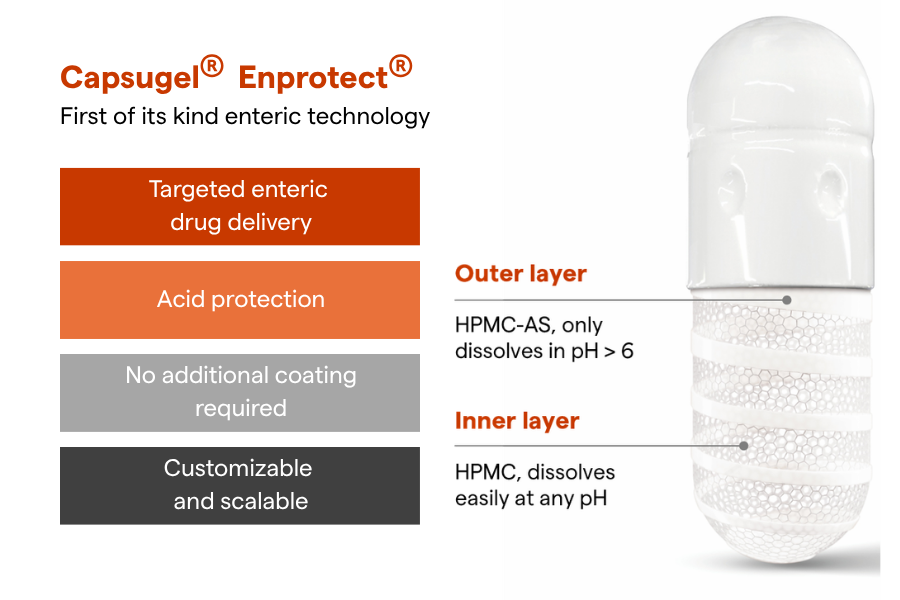
Beyond these performance characteristics, Capsugel® Enprotect® capsules also offer practical advantages for product development and manufacturing. The capsule combines gastro-resistance with a ready-to-fill format, helping simplify the formulation and production of sensitive oral therapeutics. Its enteric function is built into the capsule shell, a bilayer with an outer HPMC-AS layer over an inner HPMC layer. In compendial dissolution testing, the capsule remains intact in acidic media up to pH 6.0 and opens rapidly from pH 6.4, in line with the dissolution point of the outer HPMC-AS layer.
For sensitive payloads, integrating the enteric function directly into the capsule shell avoids the need for a separate coating step, which may expose the formulation to heat and solvents. The capsules can also be processed on standard high-speed filling equipment, reducing process complexity and limiting additional handling once the payload has been filled.
Choosing oral administration defines the route, but it does not mean that a sensitive therapeutic reaches the intestine intact. It depends on the dosage form that carries it.
The evidence presented here addresses exactly this point: the Capsugel® Enprotect® capsule protects its payload during gastric transit and releases it in the small intestine under fasted and fed conditions and preserves its biological activity along the route.
If you are developing live biotherapeutics or other acid-sensitive APIs, the Capsugel® Enprotect® capsule brings protection during gastric transit and intestinal release into the dosage form itself. Combined with a ready-to-fill format, the Capsugel® Enprotect® capsule offers a practical way to support both product performance and a simpler development and manufacturing process.
To learn more about Capsugel® Enprotect® capsule and discuss with our experts your project needs, please visit: Capsugel® Enprotect®
- Cristian RE, et al. “Microbiome-based therapeutics for Clostridioides difficile infection: additive, subtractive, and modulatory strategies in modern clinical practice”, Gut Microbes 2026, 18 (1) https://doi.org/10.1080/19490976.2026.2722482
- Alqahtani MS, et al. “Advances in Oral Drug Delivery.” Frontiers in pharmacology vol. 12 618411. 19 Feb. 2021, https://doi.org/10.3389/fphar.2021.618411
- Heavey MK, et al. “Discovery and delivery strategies for engineered live biotherapeutic products.” Trends in Biotechnology, 2021; 40, 354-369 https://doi.org/10.1016/j.tibtech.2021.08.002
- Knopp MM, et al. Utilizing the dynamic gastrointestinal model (DGM) to evaluate the gastric integrity of Capsugel® Enprotect® capsules in fasted and fed states. Eur J Pharm Biopharm 2026; 219:114962. https://doi.org/10.1016/j.ejpb.2025.114962
- Rump A, et al. In vivo evaluation of a gastro-resistant HPMC-based “next generation enteric” capsule. Pharmaceutics. 2022;14(10):1999. https://doi.org/10.3390/pharmaceutics14101999
- Grimm M, et al. In vivo evaluation of a gastro-resistant Enprotect® capsule under postprandial conditions. Pharmaceutics. 2023;15(11):2576. https://doi.org/10.3390/pharmaceutics15112576
- Grimm M, et al. In vivo comparison of enteric capsule shells composed of different HPMCAS grades after simultaneous intake by dual MRI labeling and pharmacokinetics. Int J Pharm X. 2026;12:100666. https://doi.org/10.1016/j.ijpx.2026.100666
- Jannin V, et al. In vitro evaluation of the gastrointestinal delivery of acid-sensitive pancrelipase in a next generation enteric capsule using an exocrine pancreatic insufficiency disease model. Int J Pharm. 2023;630:122441. https://doi.org/10.1016/j.ijpharm.2022.122441