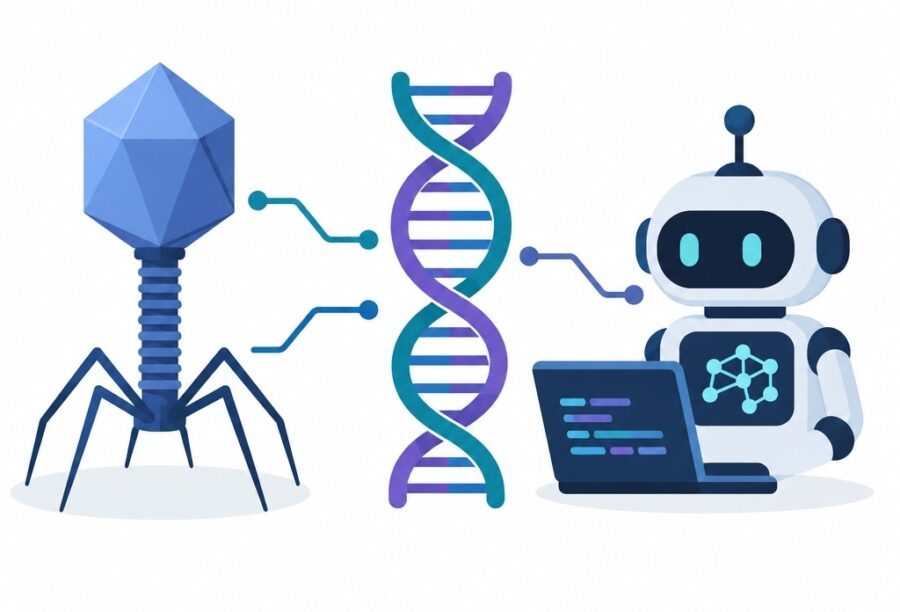
Anthropic’s life sciences research group has used its Claude AI agents to autonomously discover a previously unknown enzyme system in bacterial viruses, an early example of AI contributing a genuine biological discovery rather than assisting with analysis of an already-known finding.
The newly identified system, which the team calls array-associated reverse transcriptases (ART), pairs a reverse transcriptase enzyme with a partner gene and an array of evenly spaced DNA repeat sequences. It appears primarily in bacteriophages, the viruses that infect bacteria. The repeat pattern resembles CRISPR arrays, suggesting the system may be programmable for DNA-related operations, and early experiments show the ART array expresses distinct short RNAs, similar to how CRISPR systems behave. The reverse transcriptase itself had been identified in prior research, but Claude was the first to recognize the defining characteristics of the complete system around it.
To find it, roughly 950 Claude agents searched through massive DNA sequence databases, consuming 210 million tokens of computation over 21 hours. The agents reviewed relevant literature, reproduced established results, and flagged genomic neighbors with no known function. That process generated more than 200,000 reverse-transcriptase candidates, which Claude narrowed first to 3,500 systems and then to 20 compelling candidates for laboratory follow-up. From there, human scientists carried out all of the actual laboratory work — biochemical and structural characterization using standard laboratory strains, at BSL-1 and BSL-2 biosafety levels.
The discovery follows a pattern with precedent in molecular biology: restriction enzymes, Taq polymerase, and CRISPR itself were each first noticed as an unusual, unexplained pattern in DNA before their function — and their utility as laboratory tools — was understood.
Feng Zhang, a pioneer of CRISPR genome editing and a professor at MIT and the Broad Institute, said:
“This is an exciting example of how AI agents can contribute to biological discovery. The identification of RNA-repeat arrays associated with reverse transcriptases is genuinely intriguing and merits further investigation. I hope this work encourages more scientists to explore how AI can support their research.”
Anthropic has published a pre-print technical report describing the work in full and says it welcomes collaboration from other researchers pursuing similar questions in genomic discovery.
About Anthropic
Anthropic is an AI safety and research company that builds reliable, interpretable, and steerable AI systems. Its life sciences research group, based at Anthropic’s Bay Area location, applies Claude to fundamental biology research, including systematically reading DNA sequence data to identify uncharacterized biological systems, operating within BSL-1 and BSL-2 laboratory settings.