
Lucas Cusin
Global Technical Marketing Manager, Oral Drug Delivery Solutions
As oral drug delivery moves beyond the small intestine, ileocolonic targeting is emerging as a key enabler for next‑generation therapeutics. This article explores how colonic delivery technologies – including pH‑dependent polymers, multi‑trigger coatings and ready‑to‑fill capsules – are expanding access for live biotherapeutic products, biologics, nucleotides and microbiome‑based therapies while improving reliability, safety and performance in the gastrointestinal tract.
Colonic delivery – A gateway for novel oral therapeutics
Over the past decade, the focus of oral drug delivery has shifted downstream. What was once a niche market limited to mesalazine or budesonide for inflammatory bowel disease (IBD) has become a strategic gateway for live biotherapeutic products (LBPs), peptides/biologics, nucleotides, and even poorly soluble small molecules that need protection from the upper gastrointestinal (GI) tract. The reason is simple: where a drug is released is as important as how much is delivered.
The colon has lower luminal enzyme activity and a distinct transporter landscape. These features can be exploited to increase local exposure and improve the bioavailability of suitable modalities. Yet variability in the pH of the GI and altered transit due to disease can compromise single‑trigger enteric systems. This is why robust, multi‑trigger strategies and fit‑for‑purpose dosage forms are now leading the way.
One target, different approaches
Whether your goal is to overcome colon-targeted delivery challenges or accelerate time-to-market, there are different strategies available to reach the colon. These strategies have evolved over the years from standard pH-dependent polymers to more complex technologies and ready-to-fill, delayed-release capsules.
Standard approaches rely on single‑trigger mechanisms such as pH‑dependent coatings (e.g., classic enteric polymers), and time‑dependent systems that delay release until the dosage form reaches the distal gut. One example of this approach includes the widely known EUDRAGIT® polymers that have been on the market for over 70 years.
More recently, EUDRACAP® colon, which uses a robust pH‑triggered EUDRAGIT®-based coating, has been designed to protect payloads through the upper GI tract before dissolving at the ileo-colonic region.
Other approaches include advanced technologies that incorporate multi‑trigger or physiologically responsive mechanisms that offer greater reliability despite inter‑patient variability. These include Phloral™, a dual pH‑ and microbiota‑triggered film coating that ensures fail‑safe colonic release, and DuoCoat™, which uses a layered architecture combining an enteric shield with an internal reactive layer that activates selectively in the colon.
Additional advanced systems described in recent literature integrate enzyme‑responsive matrices, nanotechnology-based carriers, and hybrid systems that respond simultaneously to pH, transit time, and microbial enzymes. Together, these technologies represent the current spectrum of colon‑delivery strategies, from traditional single‑mechanism coatings to sophisticated, multi‑trigger platforms capable of highly precise, site‑specific drug release (Agrawal, 2025; Bansal, 2026). Below, we take a closer look at strategies using the well-known EUDRAGIT® polymers as a base, but with improved offset.
The gold standard – pH dependent polymers
EUDRAGIT® polymers which are pH‑dependent remain the gold standard and most widely used technology for colonic and distal‑ileum targeting because of their long clinical history, excellent regulatory acceptance, and unmatched formulation versatility. Classical grades such as EUDRAGIT® S 100, or FS 30 D (dissolution threshold pH ~7.0) and EUDRAGIT® L 100 (pH ~6.0), enable highly predictable, site‑specific release based solely on well‑defined gastrointestinal pH gradients. These grades form the backbone of many established IBD and colonic‑delivery drug products. The robustness of these polymers is demonstrated in the widely marketed mesalazine medicines that use EUDRAGIT®‑based enteric coatings to protect the drug through the upper GI tract and release it effectively in the colon.
EUDRAGIT® polymers (e.g., FS 30 D and L 30 D‑55) can be processed in aqueous dispersions to precisely tune the release from pH 5.5 to about 7 by adjusting polymer ratios or by partial neutralization of carboxyl groups. This enables accurate GI targeting for a wide range of APIs. EUDRAGIT® L 100 and S 100 can also be applied using solvent‑free rotor‑granulation dry‑coating technology to form cohesive protective films without high water or solvent exposure. This is advantageous for APIs that are sensitive to moisture or solvents, and it achieves coating times up to six times faster than conventional aqueous processes (Kathuria, 2011).
Additionally, EUDRAGIT® polymers support multiparticulates, pellets, granules, capsules, and tablets. They can be engineered into alcohol‑resistant modified‑release coatings that ensure stability under FDA‑required ethanol challenge conditions. This has been demonstrated for naloxone and metoprolol multiparticulates (Joshi, 2014). The broad processability of EUDRAGIT® polymers, compatibility with diverse manufacturing technologies, and proven clinical performance over decades has firmly establish pH‑dependent EUDRAGIT® coatings as the chosen platform for reliable, scalable, and customizable colonic delivery.
When more is needed, a fail-safe system
Phloral™ is a dual‑trigger colonic delivery technology designed to provide highly reliable, site‑specific release of oral drugs. It combines two independent mechanisms, pH‑dependent dissolution and microbiota‑mediated enzymatic degradation, into a single coating (Figure 1.a). Early clinical work by Ibekwe et al. demonstrated that this combined pH‑responsive, bacterially triggered matrix coating (Eudragit® S + resistant starch) consistently disintegrated at the ileocecal region, regardless of feeding state. This overcomes the well‑documented variability of classic pH‑only enteric coatings.
Subsequent research from Varum et al. confirmed that incorporating resistant starch does not compromise the integrity of the pH‑trigger. Instead, it adds a microbial trigger that ensures robust colonic release, even when the luminal pH fails to reach the polymer’s dissolution threshold. This is a common limitation in patients with ulcerative colitis and Crohn’s disease. Phloral™ has been clinically validated in large Phase III trials (817 subjects) using mesalazine. These trials demonstrated superior consistency, reduced inter‑subject variability, and reliable performance in both healthy and diseased states (D’Haens, 2017).
Phloral™ has been shown to overcome the physiological variability that undermines conventional enteric or time‑dependent systems. This improves therapeutic effectiveness, dosing reliability, and patient outcomes.
Unmatched protection and rapid onset
DuoCoat® is an advanced, dual‑layer, enteric coating technology designed to deliver drugs rapidly and reliably to the ileocolonic region. It overcomes the key limitations of conventional pH‑dependent systems. DuoCoat® consists of an outer enteric layer (e.g., EUDRAGIT® S 100) that protects the formulation during gastric transit. It also has an inner partially neutralized enteric polymer layer that is enhanced with a buffer agent. This agent accelerates dissolution once intestinal fluid penetrates the coating, enabling a rapid onset of drug release precisely at the target region (Figure 1.b).
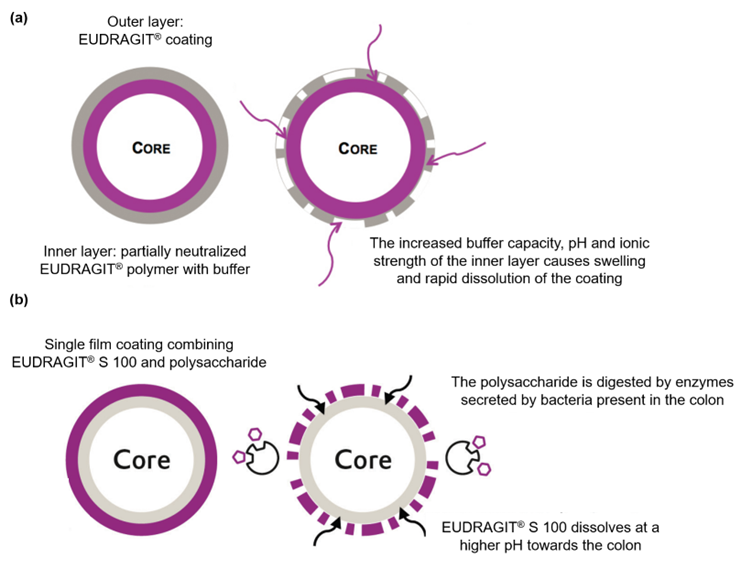
Figure 1. Structure and targeted release design of DuoCoat® (a) and Phloral® (b).
This buffer‑driven acceleration mechanism significantly reduces inter‑ and intra‑subject variability and allows fast release even under challenging physiological conditions, such as fluctuating ileocecal pH or shortened transit times in IBD patients. DuoCoat® achieves more than twice the release speed of conventional enteric polymers and exhibits improved consistency in vivo due to its increased buffer capacity, pH‑responsive swelling behavior, and robustness against environmental variability. These advantages make DuoCoat® valuable for APIs requiring rapid absorption windows, poorly soluble drugs, and life‑cycle management where enhanced performance differentiates products.
DuoCoat® can also be used in combination with Phloral®. This combination has been clinically proven with human data demonstrating reliable performance across subjects (Varum, 2020). Overall, DuoCoat® is a next‑generation ileocolonic targeting solution that enhances therapeutic reliability, improves bioavailability, and expands formulation possibilities for small molecules and complex biologics.
For streamlined development and sensitive APIs
EUDRACAP® colon is a standardized, ready‑to‑fill oral dosage technology designed for precise ileo‑colonic targeting. It uses proprietary combinations of EUDRAGIT® polymers to deliver sensitive actives, especially live biotherapeutic products (LBPs), without exposing them to the heat and moisture of conventional coating processes.
EUDRACAP® colon provides complete gastric resistance, no release at pH 6.8, and fast release starting at pH 7.2. This aligns with the physiological conditions at the ileocecal junction and early colon, making it ideally suited for microbiome therapies and other pH‑sensitive APIs. Beyond the standard capsule products, the platform expands into a fully customizable development toolkit through EUDRACAP® Select, which allows tailoring of coating thickness, polymer ratios, and performance to meet the needs of challenging APIs.
A customized EUDRACAP® Select capsule was developed for MaaT Pharma’s full‑ecosystem microbiota therapy MaaT033, demonstrating robust acid resistance, targeted release at pH 7.2, and stability under refrigerated storage. In a Phase 1b clinical trial, MaaT033 exhibited strong and sustained microbiota engraftment in acute myeloid leukemia patients following chemotherapy and antibiotics (Cusin, 2024). Together, EUDRACAP® colon and EUDRACAP® Select enable a unique continuum from off‑the‑shelf standard colonic delivery to fully customized clinical solutions for next‑generation oral therapeutics.
A flexible set of tools for different challenges
Taken together, the range of technologies described here illustrates how colonic delivery has evolved from traditional pH dependent coatings to more adaptable and physiologically responsive systems. Standard EUDRAGIT® polymers continue to provide a reliable foundation for pH triggered release, while multi-trigger coatings such as Phloral™ and accelerated release architectures like DuoCoat® offer additional robustness where physiological variability may challenge classical approaches. Ready-to-fill options such as EUDRACAP® colon and its customizable counterpart, EUDRACAP® Select, further extend these capabilities by enabling targeted delivery for sensitive APIs without exposing them to demanding coating processes. Together, these technologies give developers a flexible set of tools to match release profiles, formulation constraints, and therapeutic goals, supporting the design of oral products tailored to the diverse demands of modern colonic drug delivery.
To learn more about Evonik’s oral drug delivery solutions, please visit: https://www.evonik.com/en/company/businesslines/hc/drug-delivery/oral-drug-delivery.html
References
- Ibekwe, V. C., Khela, M. K., Evans, D. F., & Basit, A. W. (2008). A new concept in colonic drug targeting: A combined pH‑responsive and bacterially‑triggered drug delivery technology. Alimentary Pharmacology & Therapeutics, 28, 911–916.
- Varum, F., Freire, A. C., Fadda, H. M., Bravo, R., & Basit, A. W. (2020). A dual pH and microbiota‑triggered coating (Phloral™) for fail‑safe colonic drug release. International Journal of Pharmaceutics, 583, 119379.
- D’Haens GR, Sandborn WJ, Zou G, Stitt LW, Rutgeerts PJ, Gilgen D, Jairath V, Hindryckx P, Shackelton LM, Vandervoort MK, Parker CE, Muller C, Pai RK, Levchenko O, Marakhouski Y, Horynski M, Mikhailova E, Kharchenko N, Pimanov S, Feagan BG. Randomised non-inferiority trial: 1600 mg versus 400 mg tablets of mesalazine for the treatment of mild-to-moderate ulcerative colitis. Aliment Pharmacol Ther. 2017 Aug;46(3):292-302. doi: 10.1111/apt.14164. Epub 2017 Jun 1. PMID: 28568974.
- Evonik Industries. (2018). The use of advanced pH, time or microbial‑dependent oral drug delivery technologies for precise release in the colon. American Pharmaceutical Review, Sept/Oct 2018, 100–103.
- Agrawal, N. S. (2025). Exploring recent advances in colon‑targeted drug delivery systems: From traditional methods to advanced technologies. Current Gastroenterology Reports, 27, 67.
- Bansal, K. M. (2026). Delivery strategies and clinical significance of oral colon‑targeted drug delivery systems. . AAPS PharmSciTech, 27(2), 92.
- Kathuria, A., Asgarzadeh, F., Engels, S., & Jensen, B. nteric protection for multiparticulates using EUDRAGIT® L 100 and EUDRAGIT® S 100 in a novel rotor‑granulation dry‑coating process. AAPS Annual Meeting Poster R6141, 2011.
- Joshi, S., Jain, V., Baer, H., & Guha, A. Alcohol‑resistant modified‑release multiparticulates using EUDRAGIT® coatings.AAPS 2014 Poster #2424.
- Cusin, L. P., Oza, K., Smith, S., Schwintner, C., Billa Nys, C., Robin, M., & Affagard, H. (2024). EUDRACAP® Select – Examining a Case from Development to Clinical Trial. Evonik and MaaT.