Fecal microbiota sampling is the backbone of modern microbiome science — but most collection kits still capture only a gram or two of stool and let oxygen-sensitive bacteria die in transit. Spanish medtech company Microviable Therapeutics says its GutAlive® kit was built to solve both problems at once, preserving the complete sample in a living, anaerobic state from the moment of collection.
The microbiome: diagnostics and therapeutics
Microbiome science and industry have grown significantly over the last decade, moving from diagnostics into therapeutics, with a primary focus on intestinal bacteria. It has been a biomedical revolution that began with exploratory science in its early days and is now generating clinically validated products backed by strong regulatory requirements and clinical evidence.
Within this evolution, intestinal bacteria and their metabolites have become key elements in the development of novel disease biomarkers, patient stratification, efficacy predictors and other diagnostic functions. Moreover, intestinal bacteria have become novel biological medicines — microbiome-based medicinal products (MMPs) — offering new solutions for multidrug-resistant infectious diseases, immuno-oncology, inflammatory disorders and other potential indications.
These breakthroughs underline the importance of fundamental science in understanding the implications and applications of intestinal bacteria for human health.
Representative microbiome samples
The intestinal microbiome has been extensively studied through fecal samples, a convenient and non-invasive route for diagnostics and the development of MMPs. That makes obtaining a truly representative sample of the intestinal microbiota essential to the quality of these studies.
Collecting only a small portion of a fecal sample may fail to represent the bigger picture — yet this is exactly what most microbiome collection kits do, gathering just one or two grams. Small-portion collection can also jeopardise future work, since no sample remains to repeat or extend analyses, risking the loss of time points or patients from a study cohort.
Collection conditions themselves can be detrimental to bacterial viability. Strict anaerobic bacteria form the core of the gut microbiome, and both collection and transport need to maintain an anaerobic atmosphere to prevent oxygen toxicity. Most microbiome collection kits instead focus on stabilising DNA with a buffer solution, without preserving — or even considering — bacterial viability.
Microviable Therapeutics takes the opposite view: that keeping a cell alive is the best way to keep its DNA stable, since the DNA remains inside the living bacterium. A collection method that keeps bacteria alive supports accurate diagnostics while also enabling bacterial isolation and the characterisation of novel strains for probiotics, microbiome-based medicinal products such as Live Biotherapeutic Products (LBPs), fecal microbiota transplantation (FMT) procedures, and other applications.
The GutAlive® microbiota kit
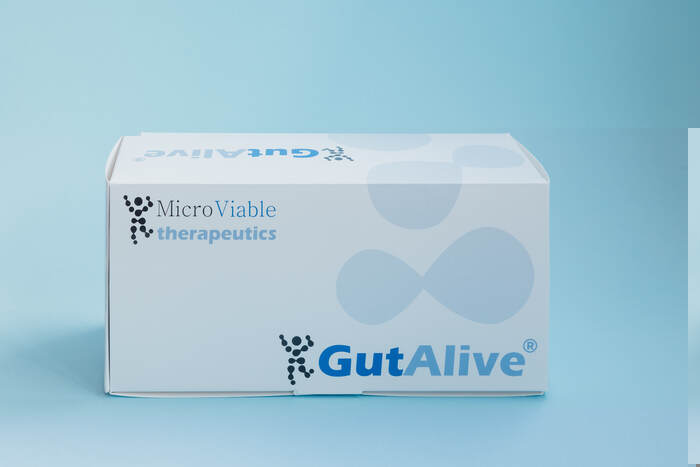
GutAlive® is a kit designed to collect and transport a complete fecal sample under anaerobic conditions.
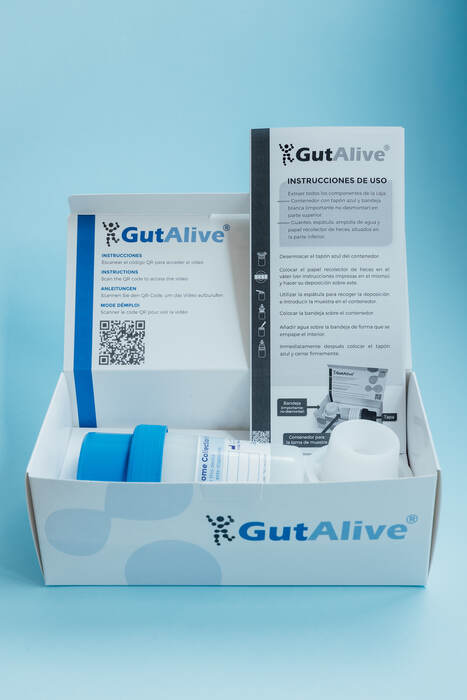
The device generates an anaerobic atmosphere inside the collection container that preserves bacterial viability at room temperature for up to 120 hours. Live bacteria provide a genuinely representative microbiota sample that can be used for microbiome analysis, isolation of strict anaerobic bacteria, FMT procedures and other applications. The anaerobic conditions build up over roughly four hours, once the anaerobic-conditions generator in the upper tray of the collector is activated. Because that reagent sits in the upper tray, nothing comes into direct contact with the sample itself, avoiding any alteration of its native state.
The anaerobic conditions and the absence of reagents in direct contact with the sample are key differentiation points with any other microbiome collection kit.Microviable Therapeutics
GutAlive® also allows users to collect a complete stool sample — up to 120 grams — without the sample-size bias introduced by most microbiome kits. Collecting the full deposition reduces the manipulation required of the donor, making the process more convenient and helping sustain donor adherence in research and clinical programmes.
A complete fecal sample also allows for proper homogenisation under laboratory conditions before use. A small amount can go toward microbiome analysis, while the remainder stays available for strain isolation and other applications, including long-term storage.
GutAlive® is designed to be user-friendly, containing everything the donor needs to collect the sample without inconvenience: the deposition can be made directly into the container or onto the provided feces catcher and then transferred using the included spatula and gloves. Instructions are provided in multiple languages, both in print and via a QR code.
GutAlive® is classified as a class A in vitro diagnostic medical device, compliant with the IVDR regulatory framework (Regulation (EU) 2017/746 on in vitro diagnostic medical devices) and is registered with EUDAMED.
The science behind GutAlive®
GutAlive® is a scientifically validated medical device, with findings published across a growing body of peer-reviewed research. The anaerobic atmosphere it generates has been tested and validated with fecal samples, demonstrating the survival of strict anaerobic bacteria such as A. muciniphila and F. prausnitzii, among others.1 In a further demonstration of the atmosphere’s quality — though the device is not intended for bacterial propagation — researchers successfully used GutAlive® as a bioreactor to grow F. prausnitzii, an extremely oxygen-sensitive anaerobe, under suitable culture media and temperature. The same study found a substantial loss of viable anaerobic gut bacteria diversity in devices that do not protect samples from oxygen exposure.
A separate research manuscript showed that GutAlive® supports DNA-based microbiome analysis by preserving the original composition and diversity of the sample, thanks to the anaerobic atmosphere that maintains bacterial viability.2 The microbiome remains stable in GutAlive® for up to 120 hours at room temperature, with no refrigeration required, reducing logistics costs. Together, these studies point to bacterial viability — rather than chemical stabilisation buffers that interact directly with the sample — as the more effective route to preventing DNA degradation.
As of September 2026, GutAlive® has been used or cited in 62 published scientific manuscripts, and is used by researchers in more than 25 countries. It has also been recommended by the Spanish Association of Gastroenterology as a suitable device for collecting fecal samples for FMT procedures.3
Conclusions
GutAlive® is a high-capacity, user-friendly kit for the self-collection of fecal samples under anaerobic conditions, stabilising the microbiome through bacterial cell viability rather than chemical fixation. These features make it suitable for DNA-based microbiome analysis and diagnostics, and open new avenues for protocol normalisation and method standardisation — while supporting other applications that require live cells, such as FMT or the isolation of anaerobic bacteria for microbiota-based medicinal product development.
GutAlive® is a registered trademark of Microviable Therapeutics SL at the EUIPO (ref. 018470344).
References
- Martínez N, Hidalgo-Cantabrana C, Delgado S, Margolles A, Sánchez B. Filling the gap between collection, transport and storage of the human gut microbiota. Scientific Reports. 2019;9(1):1–8. doi: 10.1038/s41598-019-44888-8
- Montero I, Barrientos D, Hidalgo-Cantabrana C, Martínez-Álvarez N. GutAlive® enables DNA-based microbiome analysis without disrupting the original composition and diversity. Frontiers in Microbiology. 2023;14. doi: 10.3389/fmicb.2023.1118291
- García García de Paredes A, López-Sanromán A, Foruny Olcina JR, Peñas García B, Cobo Reiniso J, del Campo Moreno R, et al. Trasplante de microbiota fecal por colonoscopia para el tratamiento de la infección recurrente por Clostridium difficile. In: Protocolos asistenciales para mejorar la Gestión interdisciplinar de las enfermedades Digestivas en el ámbito hospitalario. Asociación Española de Gastroenterología; 2019. p. 1–53.