
Oliver Hasinger
Product Manager @ Invitek Diagnostics
Gut microbiome research has changed. Many studies no longer stop at identifying which microbes are present. They are now also looking at what those microbes are doing, often by measuring the metabolites they produce or modify.
This is where metagenomics and metabolomics increasingly come together. Used side by side, they can help researchers connect microbial composition with functional output. In gut health research, that often means looking at molecules such as short-chain fatty acids (SCFA), bile acids, and tryptophan-derived metabolites, all of which are relevant to host physiology.
As this combined approach becomes more common, one practical issue deserves more attention than it usually gets: sample collection.
Why stool sample collection is critical in gut microbiome research
Stool is not a simple sample type. It is biologically complex, spatially heterogeneous, and unstable after collection. Once a sample is produced, microbial and enzymatic activity can continue. That means both DNA-based community profiles and metabolite levels may begin to shift unless the material is stabilized quickly.
This creates a challenge for multi-omics study design.
Metagenomic workflows need conditions that preserve DNA integrity, inhibit nucleases, and limit ongoing microbial growth. Metabolomic workflows also depend on rapid stabilization and historically have often relied on freezing or dedicated extraction conditions to preserve sensitive analytes.
When both analyses are planned from the same study, the collection strategy must support both from the start.
How separate-tube collection introduces variation in multi-omics studies
A common solution is to split the workflow: one tube for metagenomics, another for metabolomics. While this may seem straightforward, it introduces several sources of variation that are hard to correct later.
The first is sample heterogeneity. Stool is not uniform throughout, so two portions taken from the same bowel movement are not necessarily equivalent. If microbial profiling and metabolite analysis are performed on different subsamples, the resulting datasets may not fully describe the same biological state.
The second is timing. Even a short delay between collection steps can matter. If the two tubes are filled at different times, or stabilized using different conditions, the microbial and metabolic readouts may begin to diverge before analysis even starts.
There are also practical concerns. A two-tube workflow increases the burden on participants, particularly in home-based or decentralized studies. It adds instructions, handling steps, packaging, and potential points of error. At scale, it also increases consumables, shipping volume, and laboratory intake complexity.
Scientific advantages of single-tube stool collection for metagenomics and metabolomics
A single-tube workflow helps reduce these problems by keeping both omics layers tied to the same collection event and the same stabilized aliquot.
That matters for a few reasons:
Better sample matching
Metagenomic and metabolomic data come from the same material, rather than from separate portions of a heterogeneous sample.
Stronger cross-omics interpretation
Associations between microbial features and metabolite levels are easier to interpret when both are captured from the same biological snapshot.
Less handling-related variation
Fewer collection and processing steps mean fewer opportunities for deviation at the participant or laboratory level.
These are not just workflow improvements. They affect data quality, especially in studies where researchers are trying to detect subtle biological relationships or changes over time.
Operational benefits: room-temperature stability and simplified sample logistics
The practical case for a single-tube workflow is also strong. A unified collection format can simplify training, reduce participant confusion, and make study execution easier across multiple sites.
When room-temperature stability is available, the operational benefits become even more obvious. It can reduce reliance on cold-chain logistics and simplify shipment and storage requirements.
In practical terms, the value is simple: fewer steps, fewer variables, and a cleaner path from collection to analysis.
Key study types that benefit from single-tube multi-omics stool collection
Single-tube collection is especially relevant in studies where microbial composition and metabolic function need to be interpreted together.
This includes:
- Biomarker discovery studies, where confidence in microbiome–metabolite associations is essential
- Intervention studies, including work on therapeutics, probiotics, and dietary change, where researchers want to track coordinated shifts across both omics layers
- Large or decentralized study designs, where simpler participant workflows can improve consistency and compliance
In many of these applications, the metabolite targets are already familiar in gut research, including short‑chain fatty acids (SCFAs) such as acetate, propionate, and butyrate, as well as bile acids and tryptophan‑derived metabolites. These are often practical targets for targeted metabolomics because they are both biologically relevant and analytically tractable.
Invitek Stool Collection Tube with DNA Stabilizer: validated for gut multi-omics workflows
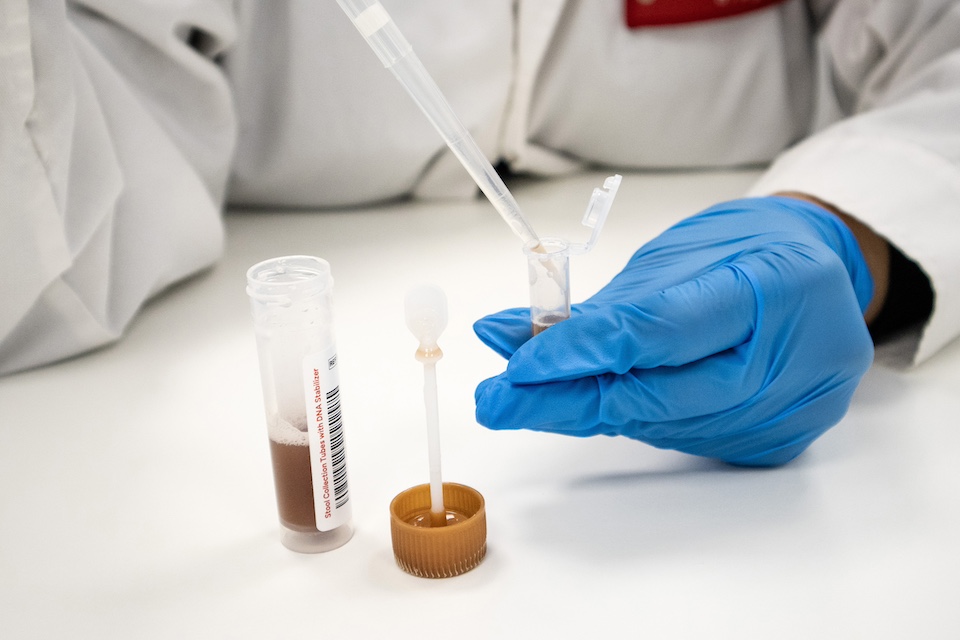
The Invitek Stool Collection Tube with DNA Stabilizer is designed to support combined multi‑omics stool workflows. It uses a proprietary liquid stabilizer to preserve bacterial DNA together with a broad spectrum of metabolites from a single stool aliquot, without requiring cold-chain transport.
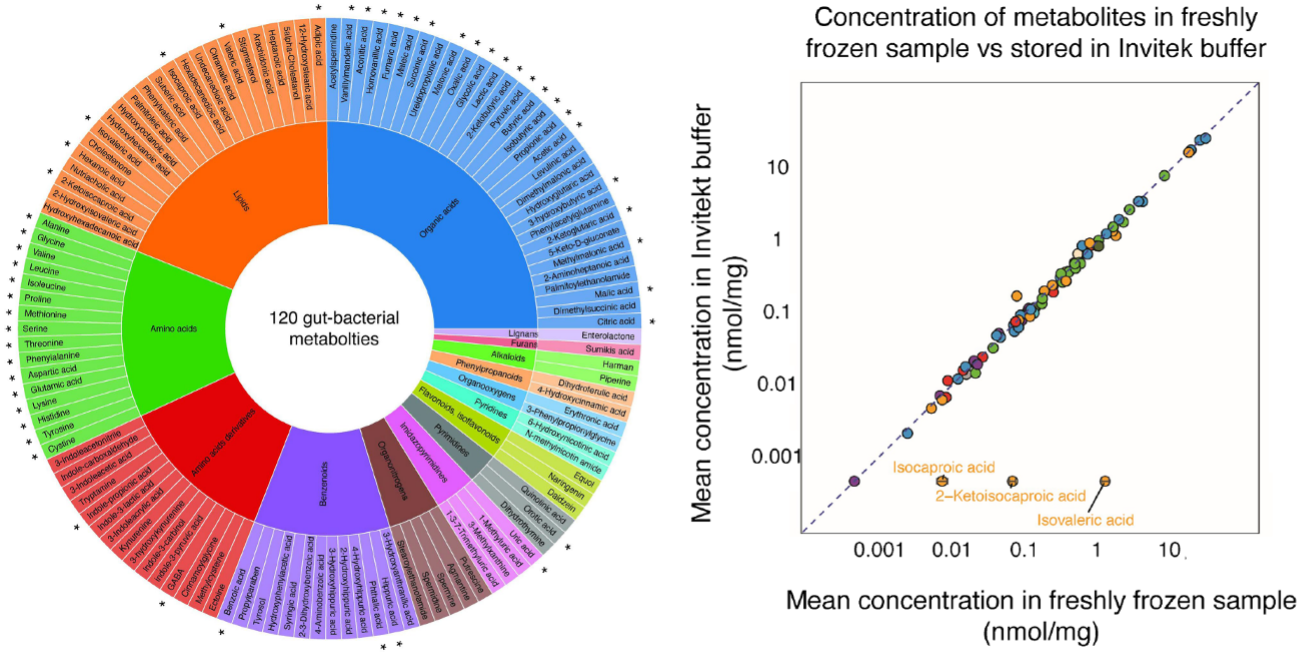
The stabilizing buffer has demonstrated strong performance in multi-omics applications. Independent comparative work reported that the Invitek Stool DNA Stabilizer preserved microbial diversity and short-chain fatty acids in close agreement with immediately snap-frozen reference samples, across storage times and temperatures [1]. In addition, metabolomic analyses have shown robust and highly accurate quantification across multiple metabolite classes from samples collected in the tubes, with compatibility for GC-MS/MS-based analytical workflows (Fig. 1; [2]).
Fig. 1: Denisov et al. demonstrated quantification of gut microbiota-derived metabolites by GC-MS/MS directly from stabilised stool samples commonly used for microbiome analysis. Metabolite levels were measured with high accuracy compared to freshly frozen samples. (Images from Denisov et al., Anal. Bioanal. Chem., 2026, [2])
Practical features of the collection tubes:
- Room-temperature DNA stability for up to three months
- Analysis of bacterial DNA and various metabolites from the same sample
- An integrated spoon for collection
- Odour-proof and leak-proof design
- Barcode-based traceability
- Compatibility with automated InviMag® DNA extraction kits and several third-party kits
Choosing the right stool collection tube for integrated metagenomics and metabolomics
In gut multi-omics, sample collection is part of the analytical strategy. If metagenomic and metabolomic data are meant to be interpreted together, it makes sense to collect them in a way that preserves that relationship from the beginning.
Separate tubes may appear manageable, but they introduce avoidable variation in sample composition, timing, and handling. A single-tube approach, such as the Stool Collection Tube with DNA Stabilizer from Invitek Diagnostics, offers a more consistent starting point for generating matched datasets from the same biological material.
For researchers building workflows that combine microbiome sequencing with metabolite analysis, that is a practical advantage worth taking seriously.
About Invitek Diagnostics
Invitek Diagnostics is a global provider of molecular diagnostics products covering the full spectrum of laboratory workflows – from sample collection and stabilization to nucleic acid extraction and target detection. With more than three decades of expertise spanning microbiome research, infectious disease diagnostics, food safety, and life sciences, Invitek serves research laboratories and diagnostic facilities worldwide. Invitek Diagnostics is a division of ALS Limited.
Resources:
[1] Gemmell MR, Jayawardana T, Koentgen S, et al. Optimised human stool sample collection for multi-omic microbiota analysis. Scientific Reports. 2024 Jul;14(1):16816. DOI: 10.1038/s41598-024-67499-4. PMID: 39039185; PMCID: PMC11263584.
[2] Denisov N, Springer F, Brauer-Nikonow A, et al. Development of a GC-MS/MS method to quantify 120 gut microbiota-derived metabolites. Analytical and Bioanalytical Chemistry. 2026 Feb;418(4):1035-1054. DOI: 10.1007/s00216-025-06256-6. PMID: 41398090; PMCID: PMC12901100.